 Login
Login

Agricultural Drone Spraying — Fertiliser Application, Safety & Awareness.
- System Administrator |
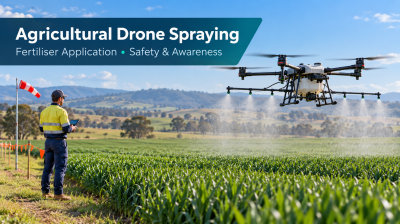
Agricultural Drone Spraying — Fertiliser Application, Safety & Awareness
Develop your understanding of safe fertiliser spreading and agricultural drone spraying through this practical awareness course. Explore how to recognise hazards, plan applications, understand equipment calibration, reduce exposure, and protect people, crops, neighbouring properties, and the environment.
The course covers ground-based fertiliser spreaders, drone application of dry materials, and drone liquid spraying. Detailed explanations, illustrated learning materials, videos, practical scenarios, and additional study resources help connect the learning to agricultural workplaces.
What you will learn
By the end of the course, you should be able to:
- Recognise hazards associated with fertilisers, agricultural chemicals, machinery, drones, and batteries.
- Explain the separate roles of aviation permissions, chemical-use requirements, product labels, and safety data sheets.
- Identify site conditions, weather, terrain, obstacles, and people that affect application planning.
- Explain basic spreader and drone calibration principles using guided calculation exercises.
- Describe safe storage, loading, handling, equipment inspection, and clean-down practices.
- Recognise spray drift risks and the need to protect waterways and sensitive areas.
- Identify when to stop work and follow workplace emergency procedures.
- Explain the importance of application records, maintenance records, and incident reporting.
Course content
| Module | Main topics |
|---|---|
| 1. Safety foundations | Responsibilities, hazard recognition, and safe-work decisions |
| 2. Permissions and product checks | Aviation requirements, chemical-use permissions, labels, and permits |
| 3. Fertilisers and material hazards | Nutrients, dust, exposure, and product information |
| 4. Site and weather planning | Terrain, obstacles, people, weather, and exclusion areas |
| 5. Ground spreading equipment | Tractor, spreader, moving machinery, and maintenance hazards |
| 6. Spreader calibration | Application rates, spread width, and distribution uniformity |
| 7. Storage and handling | Loading, mixing, exposure controls, and personal protective equipment |
| 8. Drone systems and batteries | Preflight checks, flight planning, and battery safety |
| 9. Drone dry-material spreading | Payload, distribution, and application planning |
| 10. Drone liquid spraying | Flow, speed, swath width, and calibration awareness |
| 11. Environmental protection | Drift prevention, clean-down, waste, and contamination control |
| 12. Emergency readiness | Incident response, records, and workplace preparation |
Who should enrol?
Farm workers, agricultural contractors, landholders, supervisors, farm managers, and anyone seeking an introduction to fertiliser application and agricultural drone safety.
Learning and assessment
- Duration: Approximately 4–5 hours, self-paced.
- Delivery: Online learning with diagrams, explanation notes, videos, and external study links.
- Activities: Practical scenarios, knowledge checks, two calibration calculators, and a printable workplace checklist.
- Final assessment: 30 questions with an 80% pass mark and repeat attempts.
- Completion: Review all 12 modules and pass the final assessment.
- Entry requirements: No prior drone experience required; basic numeracy is helpful.
Course status
This is a non-accredited awareness course presented in an Australian context. Completion does not provide a drone pilot licence, operator approval, chemical-use qualification, or practical competency certification. Operational work requires the applicable permissions, product-use checks, workplace procedures, and practical training.
Course Information
Coaches

System Administrator