 Login
Login

Growing Organic Food Sustainably
- System Administrator |
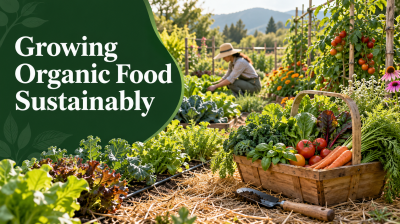
Growing Organic Food Sustainably
Learn how to grow food while caring for soil, conserving water, supporting biodiversity and reducing waste. This course introduces organic growing principles and explains how to adapt them to your local climate, available space and resources.
Designed for learners worldwide, the course covers home gardens, community growing projects, containers and beginning small-scale production. Detailed explanation notes, diagrams, videos and practical scenarios connect the learning to everyday growing decisions. It also distinguishes organic growing practices from certification and labelling requirements, which vary by country and market.
What you will learn
By the end of the course, you should be able to:
- Explain the relationship between organic growing, sustainability and certification.
- Assess a growing site and plan around local seasons and climate.
- Understand soil health, testing and responsible nutrient management.
- Describe composting principles and the safety considerations of manure-based amendments.
- Select suitable crops, varieties, seeds and establishment methods.
- Plan crop rotation, cover crops, diversity and succession planting.
- Explain water conservation and basic irrigation-volume calculations.
- Use identification, monitoring and prevention in pest and disease management.
- Choose appropriate weed-control, mulch and biodiversity practices.
- Describe harvest hygiene, storage, traceability and food-loss reduction.
- Create a realistic growing plan and measure progress.
Course modules
| Module | Main topics |
|---|---|
| 1. Organic growing foundations | Sustainability, certification and honest claims |
| 2. Site and climate planning | Sunlight, drainage, site history, local seasons and containers |
| 3. Soil health | Structure, testing, nutrients and amendments |
| 4. Composting and recycling | Feedstock, decomposition, maturity and manure safety |
| 5. Crops and propagation | Adapted varieties, seeds, seedlings and establishment |
| 6. Diverse production | Crop families, rotation, cover crops and succession |
| 7. Water management | Water sources, irrigation, drainage and conservation |
| 8. Pest and disease management | Identification, monitoring, prevention and input checks |
| 9. Weeds and biodiversity | Mulch, ground cover, habitat and local suitability |
| 10. Harvest and handling | Hygiene, water quality, storage and reducing losses |
| 11. Sustainable resources | Materials, climate resilience, fair work and costs |
| 12. Your growing plan | Records, learning trials, review and continuous improvement |
Who should enrol?
Home gardeners, community garden members, students, volunteers, educators and beginning small-scale growers interested in sustainable food production.
Delivery and assessment
- Duration: Approximately 4–5 hours, self-paced.
- Language and units: English, using metric measurements.
- Learning materials: 12 diagrams, two embedded videos, direct video links and additional reading.
- Activities: Practical scenarios, knowledge checks, study notes, two planning calculators and a printable growing-plan template.
- Assessment: 30 questions, with an 80% pass mark and unlimited retries.
- Completion: Review all 12 modules and pass the final assessment.
- Entry requirements: No previous growing experience required; basic numeracy is helpful.
Course status
This is a non-accredited knowledge course. Completion does not certify a farm or its produce, or authorise organic labelling. Learners should verify local growing guidance, food-safety requirements, permitted inputs and the certification rules relevant to their location and intended market.
Course Information
Coaches

System Administrator